
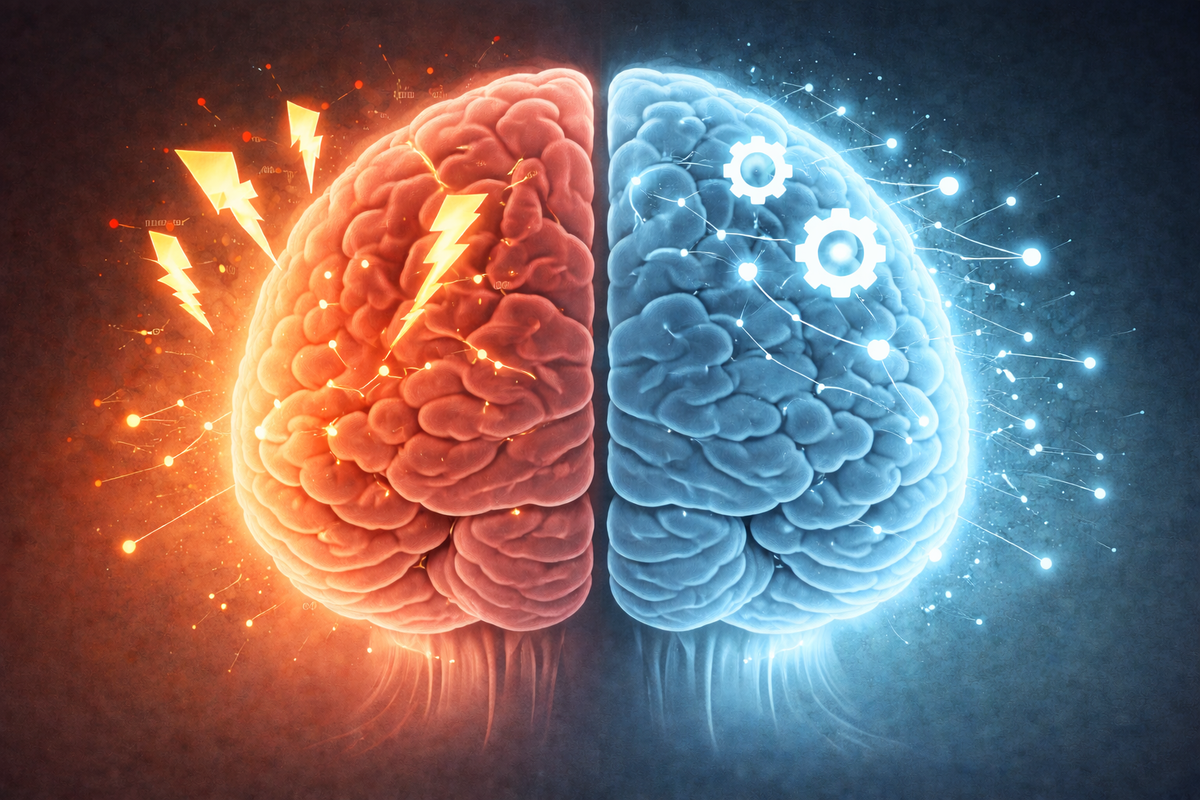
Neuroscience explains why certain management styles exhaust teams while others engage them over the long term.
Why do some teams operate under permanent tension, while others hold on over time despite comparable pressures? The answer is not just cultural or organizational. It is also biological, at the intersection of neuroendocrinology and occupational sciences.
Two hormones play a central role in the way we work together: cortisol and oxytocin. They are not anecdotal: they shape different adaptive responses to social environments and professional demands.
Cortisol: when management activates threat
Cortisol is often presented as the stress hormone, but it is more precisely the hormone of adaptation to threat and demand. It is released when the nervous system interprets a situation as threatening, for example in the face of:
- high uncertainty,
- a lack of perceived control,
- constant evaluation,
- the possibility of social or professional sanction.
This is what biomedical sciences measure via the secretion of salivary cortisol in contexts of psychosocial stress: levels Higher levels are associated with increased activation of the stress response in a professional situation. Comparative studies show, for example, that psychosocial factors at work—such as high demands combined with low control or limited social support—are linked to increased cortisol levels throughout the day in workers.
Although cortisol helps mobilize energy in the short term, chronic activation is linked to:
- decreased cognitive abilities (working memory, flexibility mental),
- a reduction in social cooperation,
- a defensive focus (protecting oneself rather than contributing),
- physiological and psychological exhaustion.
Management based on constant pressure does not increase lasting commitment: it increases conformity under constraint and cognitive dysfunction.
Oxytocin: when leadership activates relational security
Oxytocin is often nicknamed the attachment hormone, but its function is more nuanced and contextual. Recent work confirms that it plays a key role in regulating social behaviors, including attachment, cooperation, and trust.
It is released when a social environment is perceived as safe, cooperative, and supportive—for example, when interactions signal trust, genuine recognition, cooperation, and signs of fairness or social support. Recent research shows that oxytocin positively influences not only social closeness between individuals, but also prosocial behaviors and emotional regulation, even in complex emotional contexts.
Unlike cortisol, oxytocin tends to promote:
- cooperation,
- social learning,
- adaptive emotional regulation,
- taking initiative in an uncertain context.
Management that creates a link does not eliminate the requirement, but makes the demands bearable and mobilizing.
Demanding or connecting: a false dilemma
Opposing cortisol and oxytocin would be simplistic. Organizations need clarity, goals, accountability, and sometimes time pressure.
The real question is therefore not stress or no stress, but: what type of stress, and in what relational context?
Research clearly indicates that:
- demand without security relationship weakens,
- relational security without demands disengages.
The most successful environments combine high demands, trusting relationships, real autonomy and an explicit sense of work. It is this combination that allows individuals to mobilize their resources without exhausting themselves.
What this changes in concrete terms
Moving from management that “oppresses” to management that “connects” is not about charisma. It's a question of designing daily interactions, including:
- clarifying what is expected and what is negotiable,
- giving feedback on the work, not just on the results,
- normalizing error as information, not as a moral fault,
- create spaces for emotional regulation where tensions can be expressed without implicit sanction,
- be consistent — inconsistency is one of the most powerful activators of the biological stress response.
Some forms of management, such as empowering management, even show measurable protective effects on employees' cortisol, suggesting that certain practices can actually dampen the biological response to stress. stress.
In summary
Management is not just about intentions. It plays out in the biological responses that we trigger in others, day after day.
Management based solely on pressure activates biological survival. Management based on relationships activates human contribution. And between the two, they are not just different styles: they are radically different biological environments, with direct implications for the performance, health and sustainability of teams.
Want to go further?In a group in a framework of reflection strategic
References
- Matsushita, H., & Nishiki, T. I. (2025). Human social behavior and oxytocin: Molecular and neuronal mechanisms. Neuroscience, 570, 48-54.
- Folorunsho, I. L., Harry, N. M., Udegbe, D. C., & Jessa, D. (2024). Impact of oxytocin on social bonding and its potential as a treatment for social anxiety disorder. World J. Biol. Pharm. Health Science, 19, 197-204.
- Young Kuchenbecker, S., Pressman, S. D., Celniker, J., Grewen, K. M., Sumida, K. D., Jonathan, N., ... & Slavich, G. M. (2021). Oxytocin, cortisol, and cognitive control during acute and naturalistic stress. Stress, 24(4), 370-383.
- Takayanagi, Y., & Onaka, T. (2021). Roles of oxytocin in stress responses, allostasis and resilience. International Journal of Molecular Sciences, 23(1), 150.
- McEwen, B. S. (1998). Protective and damaging effects of stress mediators. New England Journal of Medicine, 338(3), 171-179.
- Arnsten, A. F. (2009). Stress signaling pathways that odd prefrontal cortex structure and function. Nature Reviews Neuroscience, 10(6), 410-422.
- Zak, P. J. (2017). Trust factor: The science of creating high-performance companies. HarperChristian+ ORM.
- Edmondson, A. C. (2018). The fearless organization: Creating psychological safety in the workplace for learning, innovation, and growth. John Wiley & Sons.
- Deci, E. L., & Ryan, R. M. (2000). The "what" and "why" of goal pursuits: Human needs and the self-determination of behavior. Psychological Inquiry, 11(4), 227-268.



Leave a comment
All comments are moderated before being published.
This site is protected by hCaptcha and the hCaptcha Privacy Policy and Terms of Service apply.