


Strengths Cards
Game description
If I asked you to name your strengths, what would your answer be? Most people are reluctant to talk about their strengths, and many don't even know what they are. According to Professor Alex Linley, “a strength is a pre-existing capacity for a particular way of behaving, thinking, or feeling that is authentic and energizing for the user, and that enables optimal functioning, development, and performance.” In fact, the concept of strengths is so central to positive psychology today that understanding and utilizing strengths is considered one of the most direct paths to personal and professional fulfillment.
Research indicates that high-achieving students are aware of their abilities and set goals slightly above their current performance level, while low-achieving students are unaware of their abilities and often set unrealistic goals. Essentially, high achievers build their personal lives and careers on their talents and strengths. They learn to recognize their talents and develop them further. They find the roles that best suit them and they invent ways to apply their talents and strengths in their lives. As for weaknesses, they manage them rather than develop them.
Research shows that simply identifying your strengths leads to increased well-being. Using your strengths at work – for greater engagement and performance.
The 50 strengths in this pack are a synthesis of all existing approaches to strength classification and cover the full extent of our current scientific knowledge on strengths. (As our strengths maps are available in multiple languages, please carefully check the quantity and language selected when placing your order.)
To go further
Our in-house training courses on the theme of strengths, focusing on 4 global challenges:
Forces as a lever for engagement
Activating one's strengths in the face of stress
Leader by strength
Group strengths assessment
Discover the strengths:
- On our blog: How will your strengths be your assets for the future?
- In the blog from our Belgian partner, Evoluo
- In This blog by Camille Lamouille, Positrainer
- Giving what is a teaching blog
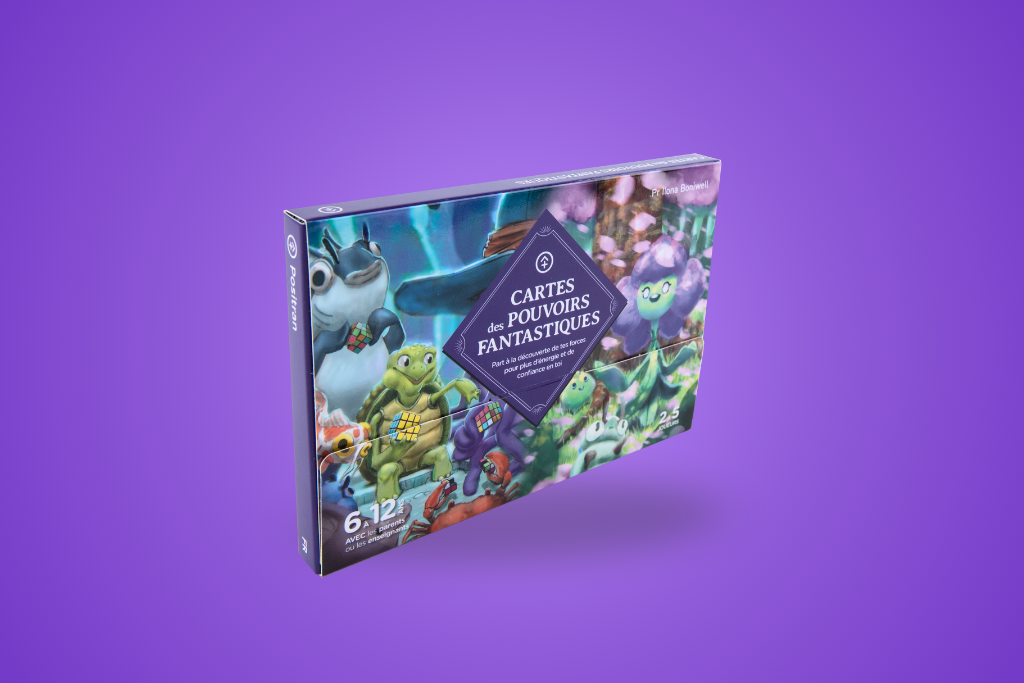
Help children develop their self-confidence with the following tool:
Who are they addressed to?
Just anyone!
Managers, project managers, trainers, psychologists, therapists, youth workers, teachers, human resources specialists and anyone curious.
How to use them?
So, how can you use these cards to identify, develop, and utilize strengths to their fullest potential? Discover examples of activities that can be carried out in one-on-one conversations and sessions, within a family circle, with friends, and, of course, in many training and team-building situations. These activities are written with the end user in mind, so if you are a coach, trainer, or therapist, please note that by “you,” we could also mean “your client.”
Strength Gym
In groups of 5 to 8, with the cards in front of you, choose three cards that you consider to be your greatest strengths. Take a look at the description and strengths questions on the back. Introduce yourself to the group by giving concrete examples of how you use these strengths (not just “I think I am a creative person”). Each group member takes turns doing this.
Next, name one or more other strengths for the other group members, giving concrete examples of when you have seen them use that strength. This exercise is contagious; you will find the whole group naming each other's strengths within minutes. It can also be very emotional.
Using forces for recruitment
Give the candidate the strengths cards or spread them out on the table. Ask the candidate to choose between 3 and 5 cards that seem most authentic to them and give some examples of how they have used these strengths in their previous professional or volunteer activities.
Using Strengths in a Professional Exam
Explain the approach to the employee. Give the strengths cards to the candidate or spread them out on a table. Ask the employee to pick three to five cards that represent their greatest strengths. Discuss the deployment of their strengths in their current position and/or their career advancement. Discuss ways to move forward (another meeting, a strengths test, creating a new job).
Examples of questions to use:
– Imagine an ideal workday/week. How would your strengths be expressed?
– In which tasks do you use your strengths the most? How can you make them more meaningful?
– How do your strengths match the needs of your team, your department, your company?
– How can your professional development allow you to make more use of what you know how to do?
Click here to learn how to use the Strengths Cards with a video.
If I asked you to name your strengths, what would your answer be? Most people are reluctant to talk about their strengths, and many don't even know what they are. According to Professor Alex Linley, “a strength is a pre-existing capacity for a particular way of behaving, thinking, or feeling that is authentic and energizing for the user, and that enables optimal functioning, development, and performance.” In fact, the concept of strengths is so central to positive psychology today that understanding and utilizing strengths is considered one of the most direct paths to personal and professional fulfillment.
Research indicates that high-achieving students are aware of their abilities and set goals slightly above their current performance level, while low-achieving students are unaware of their abilities and often set unrealistic goals. Essentially, high achievers build their personal lives and careers on their talents and strengths. They learn to recognize their talents and develop them further. They find the roles that best suit them and they invent ways to apply their talents and strengths in their lives. As for weaknesses, they manage them rather than develop them.
Research shows that simply identifying your strengths leads to increased well-being. Using your strengths at work – for greater engagement and performance.
The 50 strengths in this pack are a synthesis of all existing approaches to strength classification and cover the full extent of our current scientific knowledge on strengths. (As our strengths maps are available in multiple languages, please carefully check the quantity and language selected when placing your order.)
To go further
Our in-house training courses on the theme of strengths, focusing on 4 global challenges:
Forces as a lever for engagement
Activating one's strengths in the face of stress
Leader by strength
Group strengths assessment
Discover the strengths:
- On our blog: How will your strengths be your assets for the future?
- In the blog from our Belgian partner, Evoluo
- In This blog by Camille Lamouille, Positrainer
- Giving what is a teaching blog
Help children develop their self-confidence with the following tool:
Just anyone!
Managers, project managers, trainers, psychologists, therapists, youth workers, teachers, human resources specialists and anyone curious.
So, how can you use these cards to identify, develop, and utilize strengths to their fullest potential? Discover examples of activities that can be carried out in one-on-one conversations and sessions, within a family circle, with friends, and, of course, in many training and team-building situations. These activities are written with the end user in mind, so if you are a coach, trainer, or therapist, please note that by “you,” we could also mean “your client.”
Strength Gym
In groups of 5 to 8, with the cards in front of you, choose three cards that you consider to be your greatest strengths. Take a look at the description and strengths questions on the back. Introduce yourself to the group by giving concrete examples of how you use these strengths (not just “I think I am a creative person”). Each group member takes turns doing this.
Next, name one or more other strengths for the other group members, giving concrete examples of when you have seen them use that strength. This exercise is contagious; you will find the whole group naming each other's strengths within minutes. It can also be very emotional.
Using forces for recruitment
Give the candidate the strengths cards or spread them out on the table. Ask the candidate to choose between 3 and 5 cards that seem most authentic to them and give some examples of how they have used these strengths in their previous professional or volunteer activities.
Using Strengths in a Professional Exam
Explain the approach to the employee. Give the strengths cards to the candidate or spread them out on a table. Ask the employee to pick three to five cards that represent their greatest strengths. Discuss the deployment of their strengths in their current position and/or their career advancement. Discuss ways to move forward (another meeting, a strengths test, creating a new job).
Examples of questions to use:
– Imagine an ideal workday/week. How would your strengths be expressed?
– In which tasks do you use your strengths the most? How can you make them more meaningful?
– How do your strengths match the needs of your team, your department, your company?
– How can your professional development allow you to make more use of what you know how to do?
Click here to learn how to use the Strengths Cards with a video.
cela aide vraiment durant mes prestations de formation, ça donne du lien et de la cohésion de groupe

MERCI
Cartes forces parfaitement appropriées aux travail de renforcement positif en groupe
Très intéressant et très bon service client chez
En tant que formatrice, ces cartes sont un bon support , pour aider les personnes à se présenter, à se connaître elle même et à pousser la réflexion sur ses capacités.
Permet de travailler sur ses ressources et d'identifier le meilleur de nous même
Ce jeu de photolangage est un outil très puissant en formation et accompagnement
Our complementary products