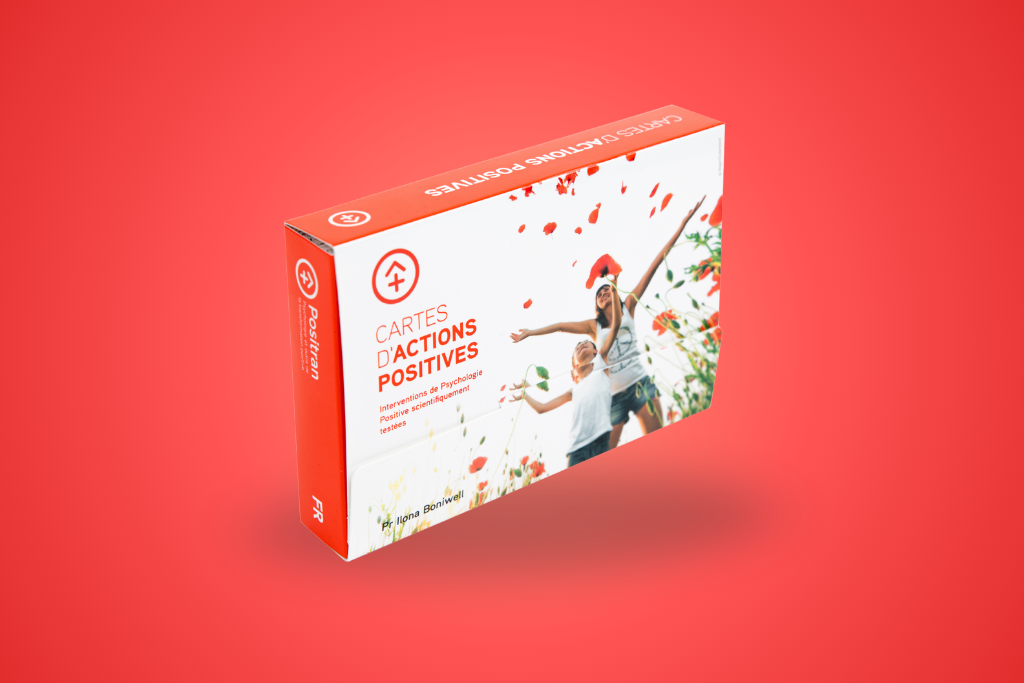


Positive Actions Cards
Based on scientifically validated positive psychology interventions, they help you to easily adopt new habits which boost your energy, optimism and inner balance.
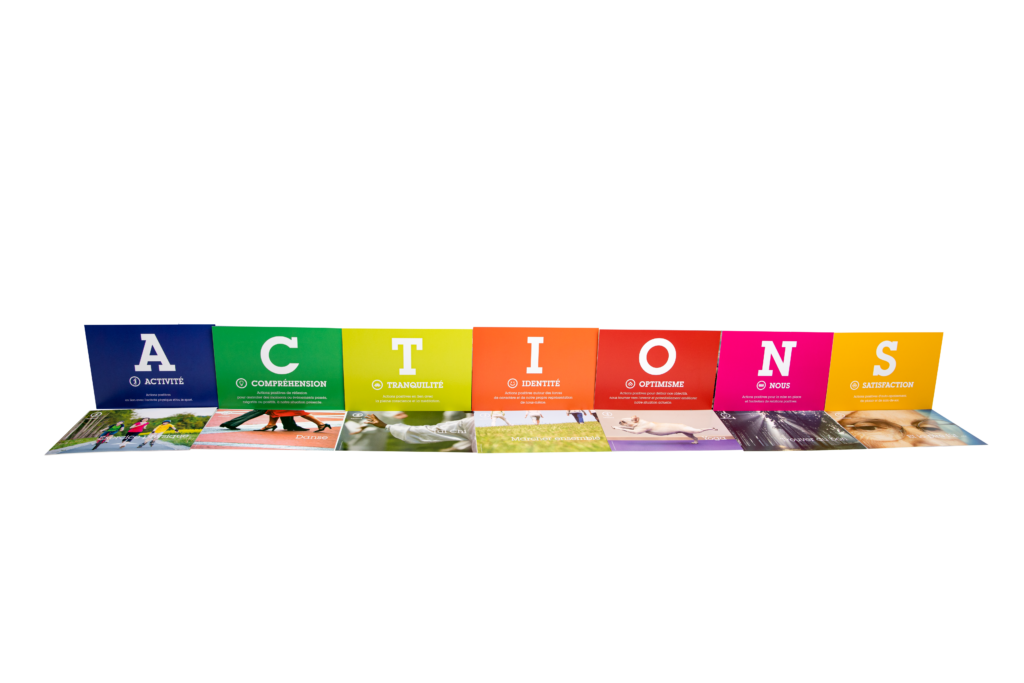
Grouped into seven categories of the acronym ACTIONSThese clear and playful cards offer concrete ideas to transform your routine, whether you are a professional coach or simply seeking lasting well-being.
Want to try it? Discover our resources on positive actions:
“Les cartes d’actions positives saisissent l’excellence des interventions en psychologie positive fondées sur des données probantes afin d’offrir aux praticiens une plateforme innovatrice qui leur permet de mettre en valeur leur caractère distinctif et de créer des actions positives avec et pour leurs clients. Un ensemble d’outils remarquable qui élève la barre de la pratique du coaching en psychologie positive. “
Product Description
Over the past few years, the notion of a “positive psychology intervention” (or PPI) has risen to prominence, as it was discovered that certain intentional actions can be effective in increasing and sustaining happiness and other positive states, as well as in reducing depression and anxiety.
A good definition of what constitutes a positive intervention is “treatment methods or intentional activities aimed at cultivating positive feelings, positive behaviours, or positive cognitions” (Sin & Lyubomirsky, 2009, p. 467).
How do we know what works and what doesn’t? What is effective, and what is less so? Here is where the science comes in! Positive interventions come tested through Randomised Controlled Trials (RCTs). RCTs involve the random allocation of participants to two or more groups and comparing the proposed intervention with another exercise intended as a placebo.
All of the actions in the set have been tested through RCTs AND have appeared in one or more meta-analyses. Considered the gold standard of applied research, a meta-analysis evaluates the overall impact of a group of interventions on our functioning.
The 64 intervention cards are organised into seven categories, which form the ACTIONS acronym.
A = Active interventions; concerned with sport and physical activity.
C = Calming actions; concerned with mindfulness and meditation.
T = Thinking or taking stock; working through and integrating past events, whether negative or positive, into our present situation.
I = Identity related actions; concerned with personal strengths and one’s representation of oneself.
O = Optimisation actions; that enable you to set goals, look to the future, and to potentially improve the current situation.
N = Nourishing actions; concerned with self-soothing, pleasure and taking care of yourself.
S = Social actions; to do with establishing and maintaining positive relationships.
Who is it for?
While anyone can use this tool to improve their own well-being, Positive Action Cards are a treasure trove for any coach or training professional. Too many positive psychology interventions rely primarily on cognitive processes, leaving clients with very few ways to truly explore well-being. This can also lead to challenging group dynamics, where session conclusions are abstract and difficult to retain.
These allow you to introduce, test and vary your interventions, resulting in greater engagement and a likelihood of continued use.
Its use
You can start with our article that invites you to practice 7 positive actions to strengthen your resilience on a daily basis.
Here are some more ideas to help you get started with the full game. These activities are written with the end user in mind, so if you are a coach, trainer, or therapist, please note that by “you,” we could also mean “your client.”
1. Action Laboratory
Alone, with a friend, or with a coach, examine all the cards and identify the actions you are currently using or have tried in the past. How did they make you feel? Did you notice any changes in yourself after implementing them? If so, what were they? Would you like to continue or start using any of these actions again? If so, which ones, why, and how?
2. What is the best fit?
Look at the cards, select the action that feels most natural to you, another (or the same one) that seems most interesting, and another (or the same one) that seems most important. How many cards do you have? One, two, or three? This action, or these actions, are probably the ones that best match your personality. On a scale of 1 to 10, how likely are you to try this action, or these actions?
3. A small step towards happiness
While many of us dream of making radical changes to our lives, these are often doomed to failure. It's much more reliable to start with very small changes. Select one new action from the pack and plan how you could realistically begin implementing it. Don't worry if you can't follow the instructions or schedule exactly. Instead, think about what you are capable of doing and the very first step you can take to integrate a new habit into your life.
4. Well-being at work
Use these cards during any training, coaching, or team-building session. First, ask each group member to share their usual ways of taking care of their well-being, before working together to develop a team-level action plan.
Over the past few years, the notion of a “positive psychology intervention” (or PPI) has risen to prominence, as it was discovered that certain intentional actions can be effective in increasing and sustaining happiness and other positive states, as well as in reducing depression and anxiety.
A good definition of what constitutes a positive intervention is “treatment methods or intentional activities aimed at cultivating positive feelings, positive behaviours, or positive cognitions” (Sin & Lyubomirsky, 2009, p. 467).
How do we know what works and what doesn’t? What is effective, and what is less so? Here is where the science comes in! Positive interventions come tested through Randomised Controlled Trials (RCTs). RCTs involve the random allocation of participants to two or more groups and comparing the proposed intervention with another exercise intended as a placebo.
All of the actions in the set have been tested through RCTs AND have appeared in one or more meta-analyses. Considered the gold standard of applied research, a meta-analysis evaluates the overall impact of a group of interventions on our functioning.
The 64 intervention cards are organised into seven categories, which form the ACTIONS acronym.
A = Active interventions; concerned with sport and physical activity.
C = Calming actions; concerned with mindfulness and meditation.
T = Thinking or taking stock; working through and integrating past events, whether negative or positive, into our present situation.
I = Identity related actions; concerned with personal strengths and one’s representation of oneself.
O = Optimisation actions; that enable you to set goals, look to the future, and to potentially improve the current situation.
N = Nourishing actions; concerned with self-soothing, pleasure and taking care of yourself.
S = Social actions; to do with establishing and maintaining positive relationships.
While anyone can use this tool to improve their own well-being, Positive Action Cards are a treasure trove for any coach or training professional. Too many positive psychology interventions rely primarily on cognitive processes, leaving clients with very few ways to truly explore well-being. This can also lead to challenging group dynamics, where session conclusions are abstract and difficult to retain.
These allow you to introduce, test and vary your interventions, resulting in greater engagement and a likelihood of continued use.
You can start with our article that invites you to practice 7 positive actions to strengthen your resilience on a daily basis.
Here are some more ideas to help you get started with the full game. These activities are written with the end user in mind, so if you are a coach, trainer, or therapist, please note that by “you,” we could also mean “your client.”
1. Action Laboratory
Alone, with a friend, or with a coach, examine all the cards and identify the actions you are currently using or have tried in the past. How did they make you feel? Did you notice any changes in yourself after implementing them? If so, what were they? Would you like to continue or start using any of these actions again? If so, which ones, why, and how?
2. What is the best fit?
Look at the cards, select the action that feels most natural to you, another (or the same one) that seems most interesting, and another (or the same one) that seems most important. How many cards do you have? One, two, or three? This action, or these actions, are probably the ones that best match your personality. On a scale of 1 to 10, how likely are you to try this action, or these actions?
3. A small step towards happiness
While many of us dream of making radical changes to our lives, these are often doomed to failure. It's much more reliable to start with very small changes. Select one new action from the pack and plan how you could realistically begin implementing it. Don't worry if you can't follow the instructions or schedule exactly. Instead, think about what you are capable of doing and the very first step you can take to integrate a new habit into your life.
4. Well-being at work
Use these cards during any training, coaching, or team-building session. First, ask each group member to share their usual ways of taking care of their well-being, before working together to develop a team-level action plan.
Our complementary products