
Motivation Cards
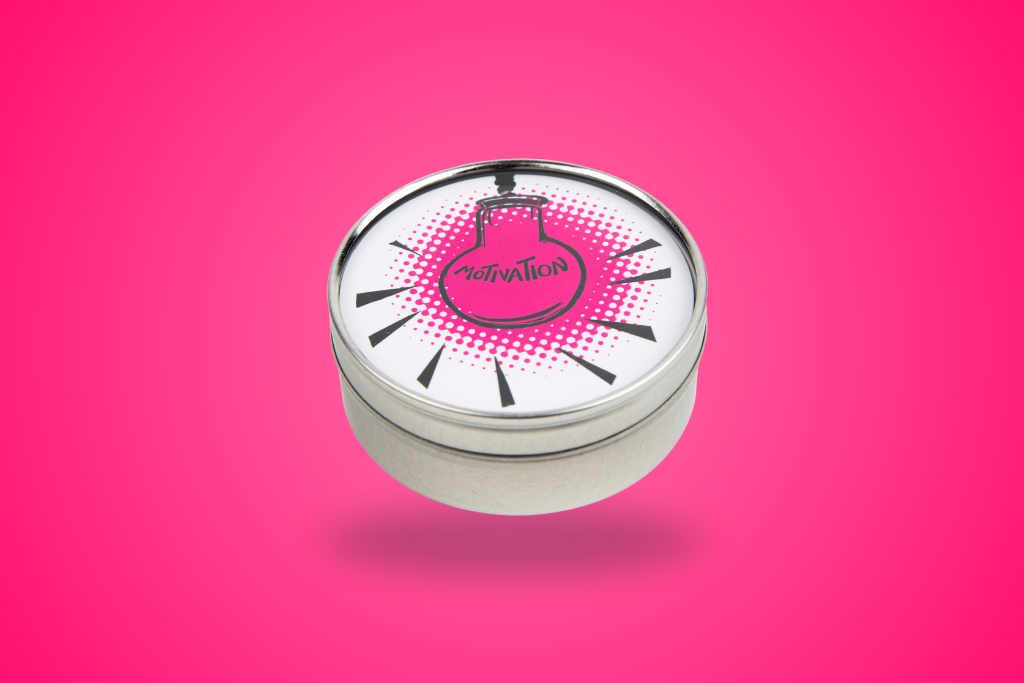
Based on science, the Motivation Cards (Mindspring) offer you an interactive way to understand why someone might feel demotivated and offer 15 scientifically proven methods to increase motivation.
Motivation is what allows us to pursue an activity with the goal of achieving personal satisfaction. While you may sometimes find it easy to move forward on your own, you may also encounter difficulties or even dead ends.
Product Description
Motivation is what drives us to take action in the hope of feeling fulfilled. Sometimes moving forward feels natural, but at other times you may face obstacles—or even become completely stuck.
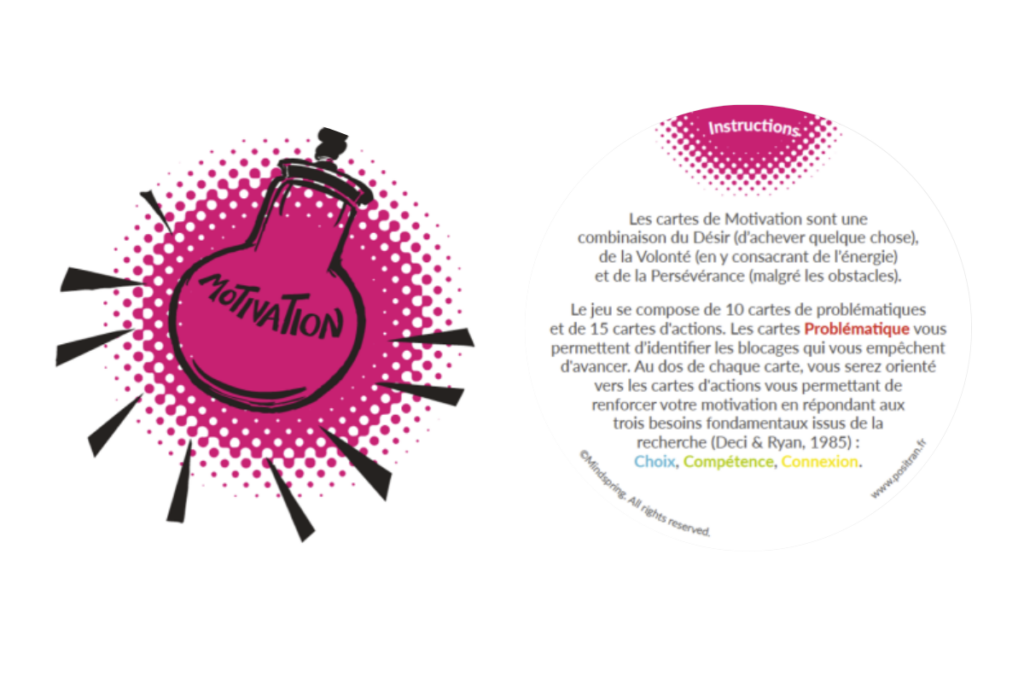
- The 10 Challenge Cards help you identify what’s blocking your progress. On the back of each card, you’ll find guidance pointing you toward the Motivation Cards.
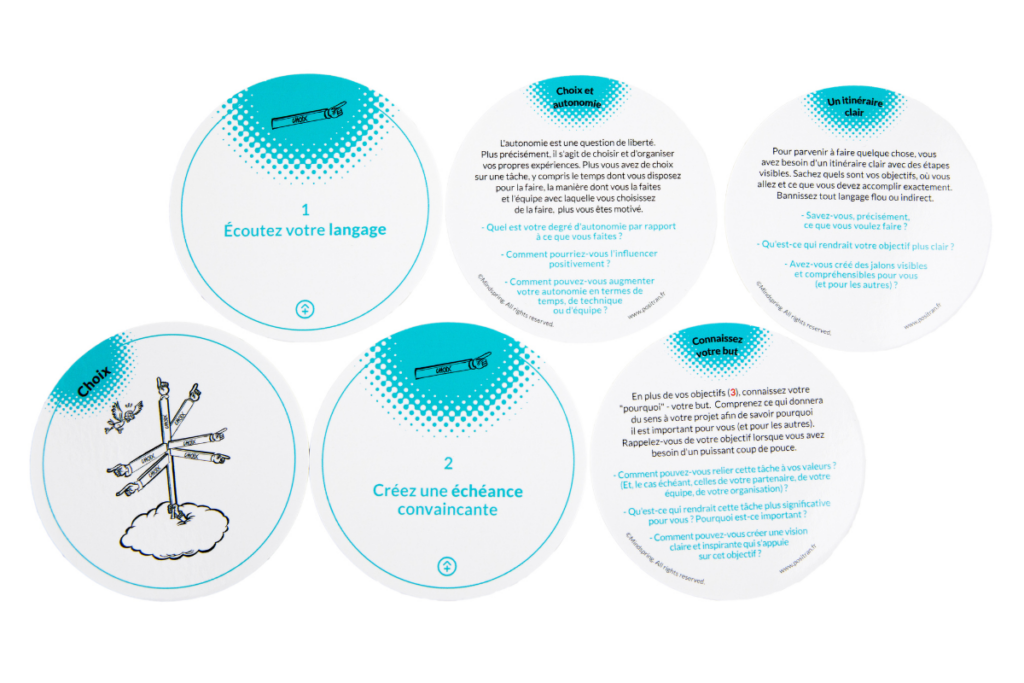
- The 15 Motivation Cards present science-based actions proven to strengthen your motivation. Each one corresponds to the three core psychological needs identified in motivation research (Deci & Ryan, 1985): Choice, Competence, and Connection.
Here are the key researchers who explored motivation in depth. Their work has been distilled into the 15 techniques included in your deck:
– Self-Determination Theory – Deci & Ryan
– Flow – Mihaly Csikszentmihalyi
– Self-Efficacy – Albert Bandura
– Positive Emotions – Barbara Fredrickson
– Mindset – Carol Dweck
– The Progress Principle – Amabile & Kramer
– Goal-Setting Theory – Edwin Locke
– Positive Psychology & Optimism – Martin Seligman
Go further :
Read more about the research behind the game.
Deepen your understanding of intrinsic motivation:
Who is it for?
Motivation Cards are designed to facilitate your coaching and training.
We use them in a variety of situations in training and coaching.
This is clearly about motivation and goal setting, but also about implementing action plans, making life and career choices, dealing with feelings of being stuck or procrastinating, improving commitment, dealing with setbacks, leading and motivating a team, dealing with self-doubt, accepting others, or boosting morale.
Its use
Tips for Using the Motivation Cards
1. Start by getting familiar with the cards:
Look through them one by one and think about the goals you’ve pursued in the past, the strategies that worked well for you, and how they connect to the different cards. Also reflect on the obstacles you’ve encountered — many of them will appear in the Challenge Cards. This personal exploration will give you plenty of concrete examples and case studies to use in conversations with your clients.
2. Introduce the 15 cards as part of a general discussion on motivation.
Present them as tools for understanding what drives engagement and what helps people move toward their goals, then review each card with the person.
3. Let the person handle the cards themselves.
Allow them to flip through the deck freely. This simple action helps them take ownership of the process and strengthens their sense of autonomy.
4. Explain the three core dimensions of motivation.
- Choice: knowing where you’re starting from and deciding to take the first step.
- Competence: making progress, learning, and dealing with setbacks.
- Connection: building relationships and finding support along the way.
These distinctions open the door to a richer, more meaningful conversation about motivation.
5. Notice which solution cards resonate most.
Everyone naturally gravitates toward certain techniques. Take time to explore the ones that stand out, and discuss how to make these strategies concrete, relevant, and applicable in daily life.
6. When someone focuses on what's not working, start with the Challenge Cards.
Many people arrive saying things like “I’m stuck” or “I keep procrastinating.” In these cases, invite them to identify the Challenge Card that best fits their situation. Then explore the suggested solutions on the back.
7. For a specific goal, use the cards as a catalyst for a coaching conversation.
They help clarify how to get started, how to maintain momentum, and what kind of support might be needed. This often leads quickly to a clear and actionable plan.
8. The cards are also highly effective when working with teams.
Choose a shared goal, then ask team members (in pairs or as a group) to go through the cards and propose specific strategies for achieving it.
9. Prioritize the strategies.
This helps create clarity and ensures everyone is aligned toward action.
10. Still focusing on the same goal, ask the team to review the Challenge Cards.
This step helps identify potential obstacles. Together, check whether the previously defined priorities still make sense in light of these challenges.
11. Build a detailed action plan with the team.
Define the steps, responsibilities, and timelines.
12. If the team lacks engagement or needs a boost, use the cards for an honest assessment.
Explore what is holding motivation back and discuss what each person can adjust to uplift the group’s energy and morale.
13. Link the cards to the motivation scale.
Identify where the person or team currently stands on the scale and discuss what actions could help them move up a level.
14. Make the cards visible in the workspace.
Encourage people to place them near their goals and check them off as they make progress. This supports clarity and consistency.
15. Give out the category cards (Challenge, Choice, Competence, Connection).
They serve as visual reminders after the session and help maintain motivation over time.
Motivation is what drives us to take action in the hope of feeling fulfilled. Sometimes moving forward feels natural, but at other times you may face obstacles—or even become completely stuck.
- The 10 Challenge Cards help you identify what’s blocking your progress. On the back of each card, you’ll find guidance pointing you toward the Motivation Cards.
- The 15 Motivation Cards present science-based actions proven to strengthen your motivation. Each one corresponds to the three core psychological needs identified in motivation research (Deci & Ryan, 1985): Choice, Competence, and Connection.
Here are the key researchers who explored motivation in depth. Their work has been distilled into the 15 techniques included in your deck:
– Self-Determination Theory – Deci & Ryan
– Flow – Mihaly Csikszentmihalyi
– Self-Efficacy – Albert Bandura
– Positive Emotions – Barbara Fredrickson
– Mindset – Carol Dweck
– The Progress Principle – Amabile & Kramer
– Goal-Setting Theory – Edwin Locke
– Positive Psychology & Optimism – Martin Seligman
Go further :
Read more about the research behind the game.
Deepen your understanding of intrinsic motivation:
Motivation Cards are designed to facilitate your coaching and training.
We use them in a variety of situations in training and coaching.
This is clearly about motivation and goal setting, but also about implementing action plans, making life and career choices, dealing with feelings of being stuck or procrastinating, improving commitment, dealing with setbacks, leading and motivating a team, dealing with self-doubt, accepting others, or boosting morale.
Tips for Using the Motivation Cards
1. Start by getting familiar with the cards:
Look through them one by one and think about the goals you’ve pursued in the past, the strategies that worked well for you, and how they connect to the different cards. Also reflect on the obstacles you’ve encountered — many of them will appear in the Challenge Cards. This personal exploration will give you plenty of concrete examples and case studies to use in conversations with your clients.
2. Introduce the 15 cards as part of a general discussion on motivation.
Present them as tools for understanding what drives engagement and what helps people move toward their goals, then review each card with the person.
3. Let the person handle the cards themselves.
Allow them to flip through the deck freely. This simple action helps them take ownership of the process and strengthens their sense of autonomy.
4. Explain the three core dimensions of motivation.
- Choice: knowing where you’re starting from and deciding to take the first step.
- Competence: making progress, learning, and dealing with setbacks.
- Connection: building relationships and finding support along the way.
These distinctions open the door to a richer, more meaningful conversation about motivation.
5. Notice which solution cards resonate most.
Everyone naturally gravitates toward certain techniques. Take time to explore the ones that stand out, and discuss how to make these strategies concrete, relevant, and applicable in daily life.
6. When someone focuses on what's not working, start with the Challenge Cards.
Many people arrive saying things like “I’m stuck” or “I keep procrastinating.” In these cases, invite them to identify the Challenge Card that best fits their situation. Then explore the suggested solutions on the back.
7. For a specific goal, use the cards as a catalyst for a coaching conversation.
They help clarify how to get started, how to maintain momentum, and what kind of support might be needed. This often leads quickly to a clear and actionable plan.
8. The cards are also highly effective when working with teams.
Choose a shared goal, then ask team members (in pairs or as a group) to go through the cards and propose specific strategies for achieving it.
9. Prioritize the strategies.
This helps create clarity and ensures everyone is aligned toward action.
10. Still focusing on the same goal, ask the team to review the Challenge Cards.
This step helps identify potential obstacles. Together, check whether the previously defined priorities still make sense in light of these challenges.
11. Build a detailed action plan with the team.
Define the steps, responsibilities, and timelines.
12. If the team lacks engagement or needs a boost, use the cards for an honest assessment.
Explore what is holding motivation back and discuss what each person can adjust to uplift the group’s energy and morale.
13. Link the cards to the motivation scale.
Identify where the person or team currently stands on the scale and discuss what actions could help them move up a level.
14. Make the cards visible in the workspace.
Encourage people to place them near their goals and check them off as they make progress. This supports clarity and consistency.
15. Give out the category cards (Challenge, Choice, Competence, Connection).
They serve as visual reminders after the session and help maintain motivation over time.
Our complementary products